

Pinecall supports two turn detection strategies, automatically selected based on your STT provider:
| STT Provider | Turn Detection | VAD | How it works |
|---|---|---|---|
deepgram/flux | Native | Native | Flux has built-in turn detection — it analyzes the audio stream and emits EagerEndOfTurn / EndOfTurn signals directly. Zero extra latency. |
deepgram/nova-3 | Smart Turn | Silero | External ML-based turn detection. Silero VAD detects speech start/stop, then SmartTurn analyzes context to decide if the user is done. |
gladia/solaria | Smart Turn | Silero | Same as Nova-3 — Silero VAD + SmartTurn. |
transcribe | Smart Turn | Silero | Same as Nova-3 — Silero VAD + SmartTurn. |
You never configure this manually. The server auto-derives the turn detection strategy from the STT provider. Just set
sttand the rest follows.
Not to be confused with
detectTurnEnd.detectTurnEndis a separate, real option onagent.dial()andagent.bridge()— it does not configure the turn-detection strategy. It controls when your greeting is delivered: by default (false) the greeting is spoken immediately on pickup (good for humans); set it totrueto wait for the other side (a bot/IVR/answering machine that greets first) to finish its own greeting before speaking yours. Whentrue, the other party's end-of-turn is also relayed to your code as aturn.endevent, so code that drives the call manually (e.g. a test/judge agent) knows when to speak. Defaultfalsefordial,trueforbridge. See Outbound Calls →detectTurnEnd.
How Flux native turn detection works#
Flux processes the audio stream and detects turns at the STT level — no separate VAD or turn analysis needed. It emits two signals:
User speaks → Flux transcribes in real-time
         ↓
   EagerEndOfTurn (high confidence the user paused)
         ↓
   SDK receives eager.turn → shows live text in UI
         ↓
   EndOfTurn (confirmed: user is done)
         ↓
   SDK receives turn.end → LLM generates response → TTS speaks
Key Flux parameters (tuneable via full STT config):
| Parameter | Default | Description |
|---|---|---|
eot_threshold | 0.7 | End-of-turn confidence. Higher = more patient before confirming END. |
eager_eot_threshold | 0.5 | Eager turn threshold. Lower = more aggressive early detection. |
eot_timeout_ms | 1000 | Max silence before forcing END regardless of threshold. |
// Default — Flux auto-tunes everything
stt: "deepgram/flux"

// Tune for slower, more patient turn detection
stt: {
  provider: "deepgram-flux",
  eot_threshold: 0.8,        // more patient
  eot_timeout_ms: 2000,      // wait longer in silence
}
How Smart Turn + Silero VAD works#
For non-Flux providers (Nova-3, Gladia, Transcribe), the server uses a two-stage pipeline:
Stage 1: Silero VAD (Voice Activity Detection)#
Silero is a local ML model that runs on every audio frame (32ms chunks). It detects when the user starts and stops speaking — nothing more.
Audio frame → Silero model → confidence score (0.0 – 1.0)
                                    ↓
                            Above threshold? → SPEAKING
                            Below threshold? → SILENCE detected
                                    ↓
                            After 350ms silence → trigger Stage 2
Silero parameters (auto-configured, no user tuning needed):
| Parameter | Default | What it does |
|---|---|---|
threshold | 0.5 | Voice confidence cutoff |
min_speech_ms | 250 | Minimum speech duration to count as real speech |
min_silence_ms | 350 | Silence duration before triggering turn analysis |
speech_end_delay_ms | 300 | Delay before emitting speech.ended |
Stage 2: SmartTurn (Turn Analysis)#
When Silero detects silence, SmartTurn analyzes the accumulated transcript to decide: is the user done, or just pausing?
Silero detects 350ms silence
         ↓
SmartTurn analyzes transcript context
         ↓
  ┌──────┴──────┐
  │             │
turn.end     turn.pause
(user done)  (user pausing — keep listening)
SmartTurn uses a small ML model to understand conversational patterns. For example:
- "What time does the" →
turn.pause(incomplete sentence) - "I need to book an appointment" →
turn.end(complete thought) - "Yeah" →
turn.end(acknowledgment) - "So I was thinking about maybe" →
turn.pause(trailing off)
SmartTurn parameters:
| Parameter | Default | What it does |
|---|---|---|
smart_turn_threshold | 0.7 | Higher = more patient (needs higher confidence to end) |
max_silence_seconds | 2.0 | Force turn.end after this much silence regardless |
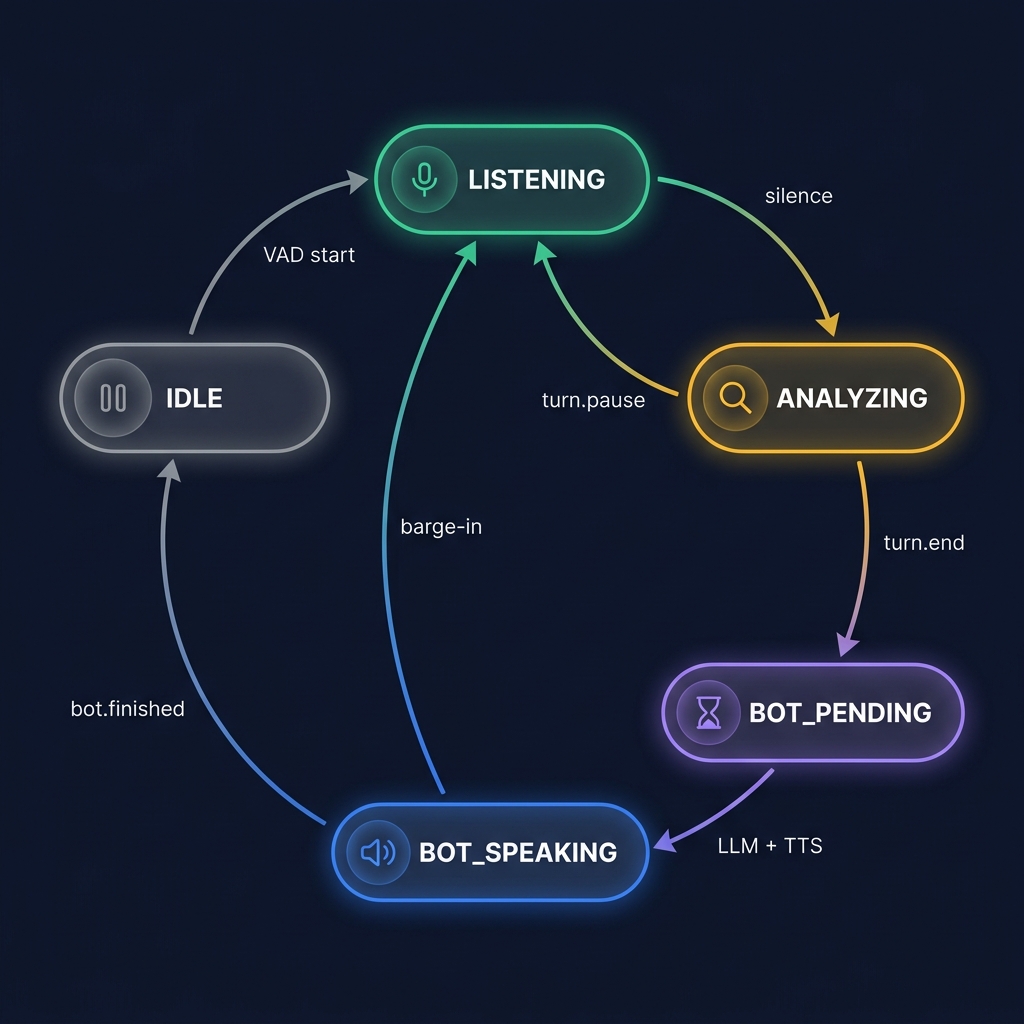
The turn state machine#
Both strategies feed into the same turn controller state machine:
Barge-in (interruption)#
When the user speaks while the bot is talking, the turn controller handles barge-in:
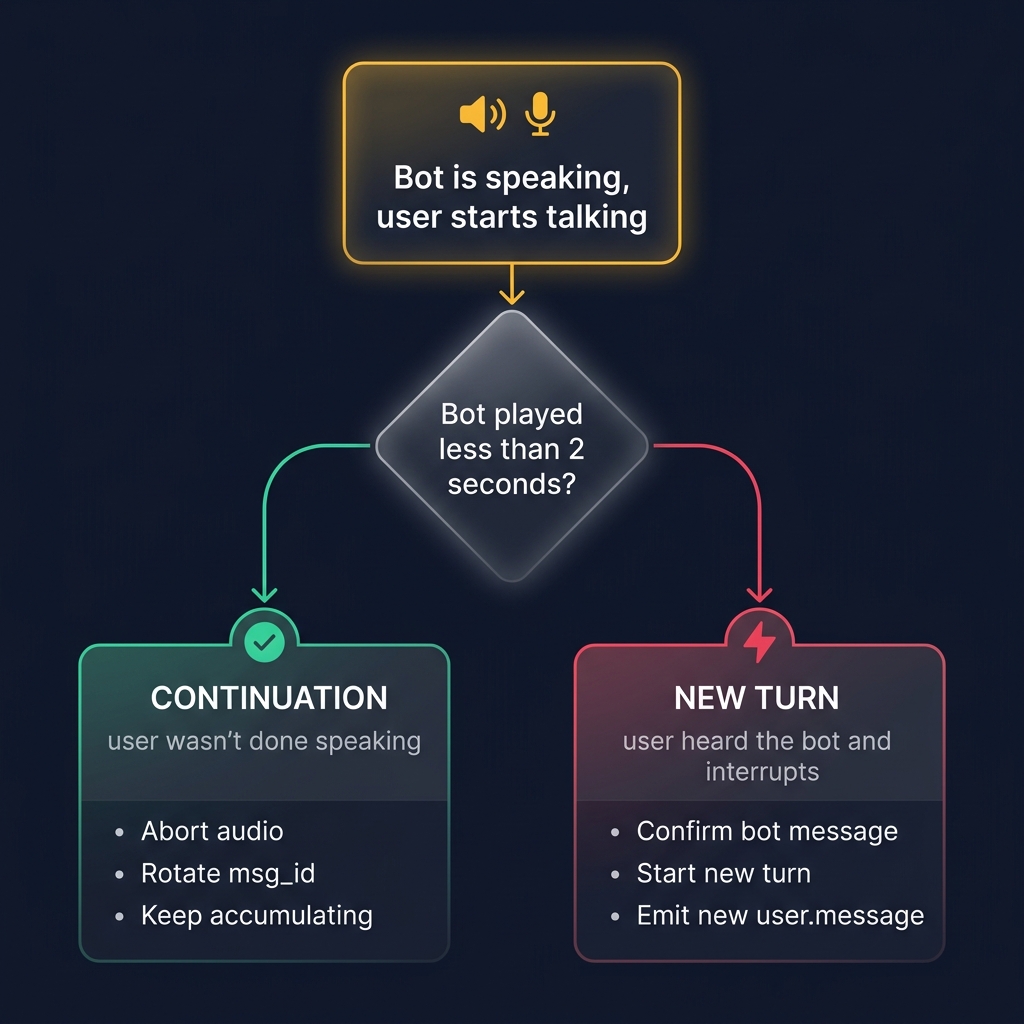
Two independent detection paths can interrupt the bot, each with its own noise gate:
- Voice path (~300ms): continuous voice must clear a higher VAD confidence bar
and a minimum smoothed loudness for
min_duration_ms. Filters TV/background noise, echo of the bot's own voice, coughs and door slams. - Transcript path (near-instant): as soon as the STT decodes words, the bot is
interrupted — but only if the transcript has at least
min_wordswords and is not a pure backchannel ("sí", "ok", "ajá", "uh-huh" — acknowledgements mean "I'm listening", not "stop talking").
Barge-in parameters (configurable via interruption):
const agent = pc.agent("support", {
  llm: "openai/gpt-5.3-chat-latest",
  stt: "deepgram/flux",
  // Barge-in config (optional — defaults are good for most cases)
  interruption: {
    min_duration_ms: 300,      // voice path: min continuous speech before interrupting
    confidence: 0.7,           // voice path: VAD confidence bar during bot speech
    min_volume: 0.35,          // voice path: smoothed loudness floor, 0–1 (0 disables)
    min_words: 2,              // transcript path: words needed to interrupt
    backchannel_filter: true,  // transcript path: "sí"/"ok"/"ajá" never interrupt
  },
});| Config | Behavior |
|---|---|
min_duration_ms: 200, min_volume: 0.25, min_words: 1 | Very sensitive — reacts to soft, brief speech |
Defaults (300ms, 0.7, 0.35, 2 words, filter on) ✅ | Balanced — filters noise and backchannels, responds to clear speech |
min_duration_ms: 400, min_volume: 0.45, min_words: 3 | Strict — requires louder, longer, wordier speech to interrupt |
false | Disabled — bot never gets interrupted |
// Disable barge-in entirely
interruption: false
Note: saying "sí sí" or "ok" while the bot talks won't cut it off — pure acknowledgements are filtered on the transcript path. Sustained real speech always interrupts through the voice path even if it fails the word gate.
SDK events#
These events fire on the Agent and Call objects:
| Event | When | Data |
|---|---|---|
speech.started | VAD detects voice | { turnId, confidence } |
user.speaking | Interim transcript available | { text, confidence } |
user.message | Final transcript confirmed | { text, messageId, turnId } |
turn.end | User finished speaking | { turnId, probability } |
turn.pause | User might continue (SmartTurn only) | { turnId, probability } |
bot.speaking | Bot starts TTS playback | { messageId, text } |
bot.finished | Bot finishes speaking | { messageId, durationMs } |
bot.interrupted | User interrupted the bot | { messageId, playedMs, reason } |
Typical event flow#
speech.started        → user starts talking
user.speaking         → "I need to..." (interim)
user.speaking         → "I need to book an..." (interim, updated)
user.message          → "I need to book an appointment" (final)
turn.end              → user is done
bot.speaking          → "Sure! When would you like to come in?"
bot.finished          → bot done speaking
speech.started        → user starts again...
Multi-language: mixing Flux and Nova-3#
When you have phone numbers in different languages, some may use Flux (native turn detection) and others Nova-3 (SmartTurn + Silero). Just set the stt provider — the server auto-configures everything else:
const agent = pc.agent("global-support", {
  prompt: "You are a multilingual support agent.",
  llm: "openai/gpt-5.3-chat-latest",
  phoneNumbers: [
    // English — Flux (native turn detection, lowest latency)
    { number: "+14155551234", language: "en", voice: "elevenlabs/sarah", stt: "deepgram/flux" },
    // Spanish — Flux multilingual (native turn detection)
    { number: "+34612345678", language: "es", voice: "elevenlabs/valentina", stt: "deepgram/flux" },
    // Arabic — Nova-3 → server auto-activates SmartTurn + Silero
    { number: "+972501234567", language: "ar", voice: "elevenlabs/ahmad", stt: "deepgram/nova-3" },
  ],
});
The turn detection strategy switches per call based on which phone number was called. English and Spanish callers get Flux's native turn detection. Arabic callers get SmartTurn + Silero. You never configure turn detection or VAD manually — the server derives them from the STT provider automatically.
Why auto-derive? Turn detection and VAD are tightly coupled to the STT provider. Flux has built-in turn signals that are faster and more accurate than any external system. Nova-3 doesn't, so the server adds SmartTurn + Silero. Exposing this as manual config would create footgun combinations (e.g. Flux with Silero VAD) that degrade quality.
What's next#
- Example: Turn Detection — runnable debug tool showing every event
- STT Providers — full provider reference with tuning parameters
- Hot-reload — swap STT provider mid-call
- Events reference — all turn-related events