

- Reject spam or blacklisted callers
- Route calls to different agents based on caller ID
- Log incoming calls for analytics
- Conditionally accept based on time of day, capacity, etc.
How it works#
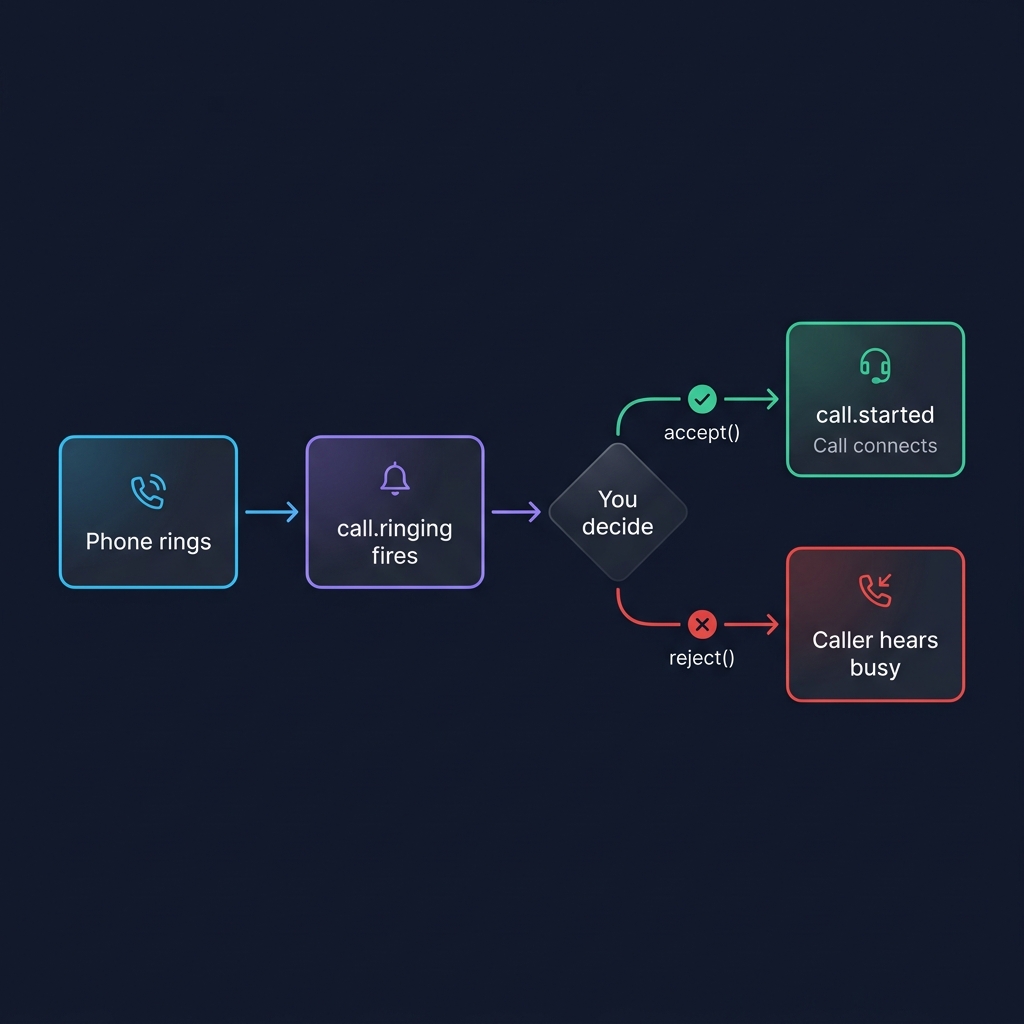
Without ringing enabled, the flow goes directly from ring → call.started (auto-accept).
Enable ringing#
Pass ringing: true in the phone number config:
const agent = pc.agent("receptionist", {
  phoneNumber: { number: "+13186330963", ringing: true },
});
Warning: Only phone channels support ringing. WebRTC and chat channels don't have a ringing phase.
Handle call.ringing#
When a call comes in, the SDK emits call.ringing with a RingingCall object. This object has caller info but no audio — the call isn't connected yet.
agent.on("call.ringing", (call) => {
  console.log(`Incoming: ${call.from} → ${call.to}`);
  console.log(`Call SID: ${call.callId}`);

  // Accept the call — proceeds to call.started
  call.accept();
});
RingingCall API#
| Property | Type | Description |
|---|---|---|
call.callId | string | Twilio Call SID |
call.from | string | Caller phone number (E.164) |
call.to | string | Called phone number (E.164) |
call.accept() | void | Accept the call — triggers call.started |
call.reject(reason?) | void | Reject the call. Reason: "busy" or "rejected" |
Reject calls#
Reject with an optional reason that maps to a Twilio rejection:
agent.on("call.ringing", (call) => {
  if (BLACKLIST.has(call.from)) {
    call.reject("busy");    // caller hears busy signal
    return;
  }
  call.accept();
});| Reason | Caller experience |
|---|---|
"busy" | Hears busy tone |
"rejected" | Call is dropped immediately |
| (none) | Defaults to "busy" |
Default behavior#
If you don't call accept() or reject() within the timeout (configurable on the server, default ~5s), the call is auto-accepted. This prevents calls from hanging indefinitely if your handler crashes.
Note: If you don't register a
call.ringinghandler at all, calls are auto-accepted immediately — same as before this feature existed. Ringing is fully opt-in.
Full example#
import { Pinecall } from "@pinecall/sdk";

const pc = new Pinecall({ apiKey: process.env.PINECALL_API_KEY });

const BLACKLIST = new Set(["+15551234567", "+15559876543"]);

const agent = pc.agent("receptionist", {
  voice: "elevenlabs/sarah",
  language: "en",
  stt: "deepgram/flux",
  llm: "openai/gpt-5.3-chat-latest",
  prompt: "You are a receptionist. Be brief and helpful.",
  // Enable ringing on the phone channel
  phoneNumber: { number: "+13186330963", ringing: true },
});

// Screen calls before answering
agent.on("call.ringing", (call) => {
  console.log(`🔔 Incoming: ${call.from}`);

  if (BLACKLIST.has(call.from)) {
    console.log(`❌ Rejected: ${call.from} (blacklisted)`);
    call.reject("busy");
    return;
  }

  console.log(`✅ Accepted: ${call.from}`);
  call.accept();
});

// Normal call lifecycle
agent.on("call.started", (call) => {
  call.say("Thanks for calling! How can I help?");
});

agent.on("call.ended", (call, reason) => {
  console.log(`📴 ${call.id} ended: ${reason} (${call.duration}s)`);
});
Run the example from the SDK repo:
cd sdk/examples/ringing
PHONE=+13186330963 node server.js
Wire protocol#
The ringing handshake uses two new events and commands:
| Direction | Message | Payload |
|---|---|---|
| Server → SDK | call.ringing | { call_id, from, to } |
| SDK → Server | call.accept | { call_id } |
| SDK → Server | call.reject | { call_id, reason } |
For full wire protocol details, see sdk-server/PROTOCOL.md.
What's next#
- Inbound Voice — the standard (non-ringing) flow
- Dev Mode — route dev calls to your local agent
- Events Reference — all SDK events